Content
A biomass gasifier is a reactor that converts solid organic material such as wood chips, rice husk, or agricultural waste into a combustible gas mixture called producer gas (or syngas) through partial combustion in a low-oxygen environment. Rather than burning the biomass completely, the gasifier limits oxygen supply to roughly 20-40% of what full combustion would require, which causes the material to break down into carbon monoxide, hydrogen, methane, and other gases that can then be burned in an engine, turbine, or burner.
This matters practically because it lets industries and rural facilities turn waste material that would otherwise be disposed of, such as crop residue or wood waste, into usable heat or electricity. A well-designed downdraft gasifier running on dry wood chips can achieve a cold gas efficiency of 70-85%, meaning most of the biomass's original energy content ends up usable in the output gas rather than lost as heat during conversion.
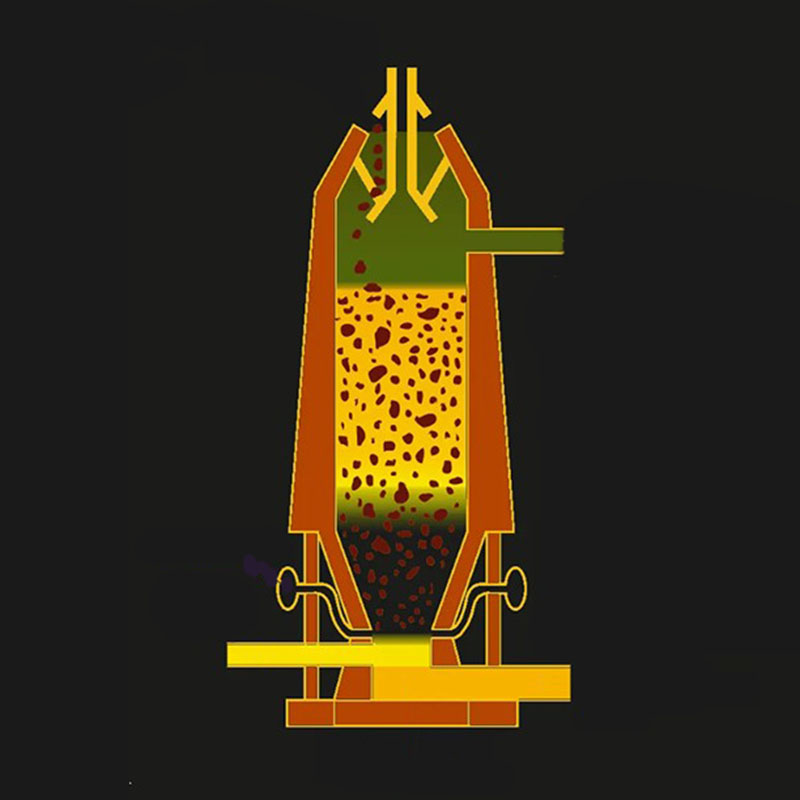
Inside a gasifier, biomass moves through four distinct thermochemical zones as it descends or passes through the reactor. Understanding these stages explains why feedstock moisture and particle size matter so much to overall performance.
At 100-200°C, moisture trapped in the biomass evaporates before any chemical breakdown begins. Feedstock with moisture above 25% forces the gasifier to spend a disproportionate share of its heat just drying material, which lowers usable gas output.
Between 200-600°C, the dried biomass thermally decomposes without oxygen, releasing volatile gases and leaving behind char. This stage produces most of the tar compounds that later need to be managed in the gas cleaning system.
Limited air injected here burns a portion of the char and volatiles, generating temperatures of 1,000-1,200°C that drive the endothermic reduction reactions happening just below.
At 700-900°C, carbon dioxide and water vapor react with remaining char to form carbon monoxide and hydrogen, the two gases that give producer gas most of its fuel value.
Gasifiers are classified primarily by how air and fuel move through the reactor relative to each other. Each design carries distinct tradeoffs in tar output, scale suitability, and feedstock tolerance.
| Gasifier Type | Tar Output | Best Scale |
|---|---|---|
| Updraft | High (10-150 g/Nm³) | Direct heat, large industrial |
| Downdraft | Low (0.1-3 g/Nm³) | Small-medium power generation |
| Cross-draft | Medium (1-3 g/Nm³) | Small-scale, charcoal feedstock |
| Fluidized Bed | Medium (1-15 g/Nm³) | Large industrial, variable feedstock |
For electricity generation through an engine, downdraft gasifiers are the most widely deployed design because their low tar output reduces the load on gas cleaning equipment and protects engine components from fouling.
Not all biomass performs equally inside a gasifier. Moisture content, ash content, and calorific value together determine how much usable gas a given feedstock will produce.
| Feedstock | Moisture Content | Calorific Value |
|---|---|---|
| Wood chips (dried) | 10-20% | 15-18 MJ/kg |
| Rice husk | 8-12% | 13-15 MJ/kg |
| Sugarcane bagasse | 15-25% | 14-16 MJ/kg |
| Coconut shells | 8-15% | 18-20 MJ/kg |
As a practical rule, feedstock should be dried to below 20% moisture content before entering most downdraft gasifiers, since wetter material drops gas calorific value and can extinguish the combustion zone entirely during operation.
The gas leaving a biomass gasifier is a mixture of combustible and inert components. Its exact ratio depends on feedstock and gasifier design, but typical downdraft output falls within a fairly consistent range.
| Component | Typical Share |
|---|---|
| Carbon monoxide (CO) | 17-22% |
| Hydrogen (H2) | 15-20% |
| Methane (CH4) | 1-3% |
| Carbon dioxide (CO2) | 10-15% |
| Nitrogen (N2) | 45-50% |
This composition gives producer gas a calorific value of roughly 4.5-5.5 MJ/Nm³, far lower than natural gas but still sufficient to run a spark-ignition engine when supplied at the correct air-fuel ratio, typically requiring engines to be derated by 20-30% compared to their rated natural gas output.
Producer gas from a biomass gasifier can be used in several distinct ways depending on the scale and end goal of the installation.
Among these, distributed power generation in the 100kW-1MW range remains the most common commercial deployment, particularly for facilities like rice mills or sawmills that already generate biomass waste on-site as a byproduct.
When comparing gasifier systems or vendors, a handful of metrics indicate whether a given design will perform reliably under real operating conditions rather than only under ideal lab settings.
This measures the percentage of biomass energy content that ends up in the cooled, cleaned producer gas. Well-designed downdraft systems reach 70-85%, while poorly insulated or oversized units can fall below 60%.
Expressed in kg of biomass consumed per hour per square meter of reactor cross-section, this determines how compact a gasifier can be for a given power output, typically ranging from 100-300 kg/h/m².
This indicates how far output can be reduced from peak capacity while maintaining stable gasification, with most fixed-bed designs supporting a 3:1 to 4:1 turndown ratio before gas quality degrades.
Most gasifier underperformance traces back to a handful of recurring operational issues, each of which has a well-established mitigation approach.
Facilities that skip a proper gas cleaning train report engine maintenance intervals shrinking from a typical 4,000-6,000 operating hours down to under 1,000 hours, making the cleaning system one of the highest-value investments in the entire setup.
Capital cost for a complete biomass gasification power system, including the gasifier, gas cleaning train, and engine-generator set, typically ranges from $800 to $1,500 per kW of installed capacity, with smaller systems carrying a higher per-kW cost due to fixed equipment overhead.
Operating cost is dominated by feedstock handling and preparation rather than the feedstock itself when waste biomass is used on-site, since the material may be effectively free while drying, chipping, and transport account for the bulk of ongoing expense. For facilities replacing diesel generation, payback periods of 2 to 4 years are commonly reported where diesel costs exceed $0.80 per liter and a steady biomass waste stream is already available.
Selecting an appropriate system depends on matching gasifier design and scale to the available feedstock and intended end use, rather than choosing based on capacity alone.
Systems sized and matched correctly to feedstock characteristics from the outset consistently outperform those selected on capacity numbers alone, since gasifier performance is far more sensitive to fuel quality than most other thermal power generation technologies.


 OEM/ODM High-Performance Combustion & Thermal Equipment Manufacturers
 English
 русский
 Français
 Español
 عربى
عربى