Content
Melting and smelting are fundamentally different processes: melting is a physical change that converts a solid metal into liquid form without altering its chemical composition, while smelting is a chemical process that extracts metal from ore by applying heat and a reducing agent to drive a chemical reaction. Confusing the two is common, but the distinction is critical for anyone working in metallurgy, industrial processing, or furnace engineering — the equipment, temperatures, energy inputs, and outputs are entirely different.
This article explains the science behind both processes, details the smelting furnace types used in modern industry, and takes a deep look at RKEF nickel smelting combustion systems — one of the most energy-intensive and technically demanding smelting operations in the world.
Understanding what separates these two processes clarifies why different furnace technologies, fuels, and operational approaches are required for each.
Melting is a physical phase change. A solid metal absorbs enough thermal energy to overcome its crystal lattice structure and becomes liquid. The chemical identity of the material does not change — iron melts into liquid iron, aluminum melts into liquid aluminum. No new substance is created. Melting is reversible: cooling the liquid returns it to solid form with the same composition.
Typical industrial melting temperatures range from 660°C for aluminum to 1,538°C for pure iron. Melting furnaces — induction furnaces, electric arc furnaces used for scrap remelting, and reverberatory furnaces — are designed to achieve and maintain these temperatures efficiently without introducing reactive chemistry.
Smelting is a chemical process. The input material is an ore — a rock or mineral containing the target metal in a chemically bound form, typically as an oxide, sulfide, or carbonate. Heat and a reducing agent (most commonly carbon in the form of coke, or carbon monoxide gas) are applied to break the chemical bonds and release the metal.
For example, iron smelting in a blast furnace converts iron ore (Fe₂O₃) using coke and limestone at temperatures exceeding 1,600°C. The product is pig iron — a new material chemically distinct from the iron ore input. Smelting is not reversible in the same sense: you cannot simply cool the output and recover the original ore.
| Feature | Melting | Smelting |
|---|---|---|
| Type of change | Physical | Chemical |
| Input material | Solid metal or alloy | Metal ore (oxide, sulfide, etc.) |
| Chemical composition | Unchanged | Transformed — new substance produced |
| Reducing agent needed | No | Yes (coke, CO, hydrogen, etc.) |
| Byproducts | None (same material, liquid state) | Slag, gases (CO₂, SO₂), dust |
| Typical temperature range | 660°C – 1,538°C | 1,200°C – 1,700°C+ |
| Reversibility | Fully reversible | Not reversible |
| Example | Melting aluminum scrap for casting | Extracting nickel from laterite ore |
A smelting furnace must do more than generate heat — it must create and sustain the specific chemical environment needed to reduce the ore, separate the metal from the slag, and handle enormous material throughputs continuously. Different metals and ore types require fundamentally different furnace designs.
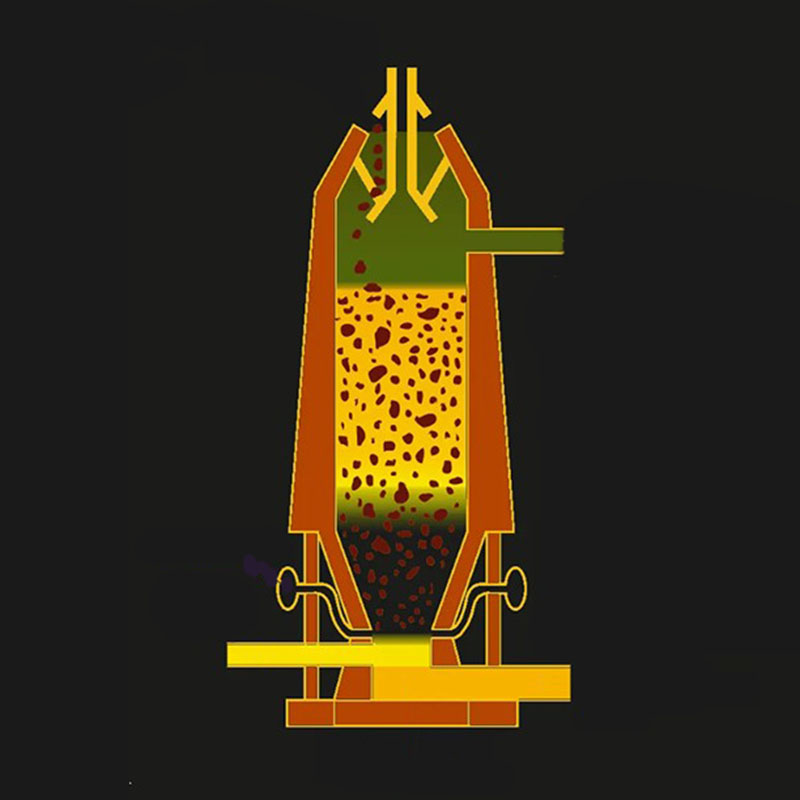
The blast furnace is the dominant technology for iron and steel production. It operates continuously, with iron ore, coke, and limestone charged from the top while preheated air (blast) is injected near the base at temperatures around 1,000–1,200°C. Internal temperatures reach up to 2,000°C in the combustion zone. Modern blast furnaces produce 5,000–10,000 tonnes of pig iron per day and have campaign lives of 15–20 years before relining.
While EAFs are widely used for melting steel scrap, they are also used for smelting in ferroalloy and nickel production. In smelting mode, the electric arc provides the energy to drive chemical reduction reactions. EAFs used for smelting typically operate at 1,500–1,700°C and consume 400–700 kWh per tonne of product, depending on the material.
Developed by Outokumpu in the 1940s and now used by over 40 smelters worldwide, flash smelting suspends finely ground ore concentrate in a stream of oxygen-enriched air. Combustion and smelting occur simultaneously in the reaction shaft in milliseconds. Flash smelting is primarily used for copper and nickel sulfide concentrates and is significantly more energy-efficient than conventional reverberatory furnace smelting — reducing energy consumption by up to 80% compared to older technology.
The RKEF system is the principal technology for processing nickel laterite ores. It combines a rotary kiln (for drying and pre-reduction) with an electric furnace (for final smelting). This two-stage approach is necessitated by the characteristics of laterite ore — a wet, clay-like material that cannot be charged directly into an electric furnace without causing dangerous steam explosions. The RKEF system is explored in detail in the sections below.
An older furnace design where burner flame heats a low-hanging roof, which radiates heat down onto the ore bath. Reverberatory furnaces were once dominant in copper smelting but have largely been replaced by flash smelting due to poor energy efficiency and high SO₂ emissions. They remain in use for secondary smelting (processing scrap and residues) due to their flexibility and lower capital cost.
The Rotary Kiln–Electric Furnace (RKEF) process is the global standard for converting nickel laterite ore into ferronickel (FeNi) — an intermediate product used in stainless steel production. Unlike nickel sulfide deposits (which are processed via flotation and flash smelting), laterite ores are oxidic and cannot be concentrated by flotation. They must be processed as whole ore, which means handling enormous volumes of wet, heterogeneous material.
The RKEF process is split into two distinct thermal stages that address the material's properties sequentially:
Transferring hot calcine directly from kiln to furnace rather than allowing it to cool is a critical energy-saving measure — it reduces electric furnace energy consumption by approximately 15–25% compared to cold-charge operation.
The combustion system in the rotary kiln stage of RKEF is one of the most demanding burner applications in industrial metallurgy. It must deliver enormous, precisely controlled heat input across a rotating cylinder that may be 60–120 meters long and 4–6 meters in diameter, processing hundreds of tonnes of ore per hour.
The choice of fuel for RKEF rotary kiln combustion systems is driven by local availability, cost, and environmental regulations. The main options are:
The rotary kiln burner for RKEF smelting typically fires from the discharge end (the hot end) of the kiln, with the flame extending back toward the feed end. Key combustion system design parameters include:
| Zone | Location | Temperature (°C) | Process Occurring |
|---|---|---|---|
| Drying zone | Feed end | 100–400°C | Free moisture evaporation |
| Calcination zone | Mid-kiln | 400–700°C | Dehydroxylation of ore minerals |
| Pre-reduction zone | Mid to hot end | 700–1,000°C | Partial reduction of NiO and Fe₂O₃ by coal/coke |
| Hot discharge | Discharge end (burner end) | 900–1,050°C | Calcine exit to electric furnace feed system |
RKEF nickel smelting is one of the most energy-intensive industrial processes in operation. The specific energy consumption varies significantly based on ore grade, moisture content, and operational efficiency, but typical figures give a clear picture of the scale involved.
By comparison, nickel production from sulfide ores via flotation and flash smelting consumes roughly 20–30 GJ per tonne of nickel — significantly less. This energy gap is a major driver of RKEF's higher production costs and growing pressure to improve combustion efficiency and electrify where possible.
Both the rotary kiln and the electric furnace in an RKEF system operate under severe thermal and chemical conditions that place enormous demands on refractory lining materials.
The kiln lining must withstand continuous rotation, thermal cycling, and chemical attack from the ore and combustion gases. High-alumina bricks (60–70% Al₂O₃) are standard in the calcination and pre-reduction zones. The hot discharge zone, which sees the most severe conditions, often uses magnesia-chrome or magnesia-spinel bricks capable of withstanding temperatures above 1,200°C under reducing atmospheres. Average refractory campaign life in RKEF kilns is 3–5 years, after which the kiln must be shut down and relined.
The EAF hearth in RKEF smelting contacts molten ferronickel at 1,550–1,650°C and highly fluid slag simultaneously. The hearth lining typically uses ramming magnesia or magnesia-carbon bricks in the metal zone and high-magnesia bricks in the slag zone. Slag composition — particularly the silica-to-magnesia ratio (the "slag basicity") — must be carefully controlled to minimize refractory dissolution. A basicity of 0.8–1.2 (MgO/SiO₂) is typical in nickel RKEF operations to balance fluidity with refractory life.
RKEF operations generate several significant environmental streams that require engineered controls.
RKEF is not the only technology available for nickel production, and understanding where it fits relative to alternatives helps explain why it dominates laterite processing despite its high energy costs.
| Technology | Ore Type | Product | Energy Use | Key Advantage |
|---|---|---|---|---|
| RKEF | Laterite (saprolite) | Ferronickel (15–40% Ni) | Very high | Handles high-Mg saprolite ore directly |
| HPAL (High-Pressure Acid Leach) | Laterite (limonite) | Mixed hydroxide precipitate | Moderate | Recovers Co as co-product; battery-grade output |
| Flash Smelting | Sulfide concentrate | Nickel matte (65–75% Ni) | Low–moderate | High throughput, SO₂ capture for acid plant |
| Caron Process | Laterite (limonite) | Nickel oxide sinter | High | Lower capital cost than HPAL |
RKEF's dominance in laterite smelting — particularly in Indonesia, which now accounts for over 50% of global nickel production — stems from its ability to handle saprolite ore grades (1.5–2.5% Ni) and deliver ferronickel directly usable in stainless steel production. As battery-grade nickel demand grows, RKEF operators are under increasing pressure to upgrade ferronickel to Class 1 nickel via the Nickel Matte Conversion process or to develop hybrid flowsheets incorporating hydrometallurgical refining.


 OEM/ODM High-Performance Combustion & Thermal Equipment Manufacturers
 English
 русский
 Français
 Español
 عربى
عربى